Does astaxanthin really improve eyesight? An honest OptiPlax myth-check
Updated August 2026 · reviewed by the OptiPlax Research Team. We are an independent information resource, not a medical provider, and this article is educational rather than medical advice.
Astaxanthin does not sharpen your prescription or reverse eye disease, and any product that promises it will is overselling. What the marine antioxidant is genuinely studied for is narrower and quieter: eye comfort, focusing fatigue and antioxidant support during heavy near-work, where a handful of small trials report modest benefits. This myth-check separates that real, limited evidence from the hype — and shows how OptiPlax describes its astaxanthin honestly, so you can judge it for yourself.
Does astaxanthin really improve eyesight — the short, honest version.
- The honest verdict
- No, it will not correct vision or cure disease. Astaxanthin is studied for eye comfort and focusing fatigue, where evidence is early and modest, not for measurable sight improvement.
- Where evidence exists
- Small human trials, often 4–12 mg daily, suggest possible help with eye strain and focus during long screen use.
- Clear red flags
- Any claim to reverse macular degeneration, dissolve cataracts, replace glasses, or produce dramatic before-and-after eyesight.
- How OptiPlax frames it
- As one antioxidant inside a 500 mg marine blend for everyday comfort support — the amount printed on the label, no disease claims.
“Astaxanthin for eyesight” is one of the most searched marine-nutrient claims online, and results range from careful summaries to breathless promises of throwing away your glasses. Both cannot be right. This article walks through what astaxanthin is, what researchers have and have not shown, which claims should make you skeptical, and how OptiPlax talks about its own.
What is astaxanthin, exactly?
Astaxanthin is a deep-red carotenoid pigment made by microalgae — chiefly Haematococcus pluvialis — and it is what turns salmon, shrimp and flamingos pink. Chemically it sits in the same carotenoid family as lutein and zeaxanthin, the pigments already known to concentrate in the eye. Its claim to fame is antioxidant capacity: in lab tests it neutralises reactive molecules efficiently, which is why it is marketed for tissues exposed to light and oxidative stress. That laboratory strength is real; the open question is how much you would ever notice in your vision.
Does astaxanthin really improve eyesight? What the evidence shows
The honest answer is that astaxanthin has not been shown to improve eyesight in the way most people mean it — it does not measurably sharpen visual acuity or correct refractive error. What a modest body of small human studies has explored instead is eye comfort and accommodation, the eye's ability to switch focus. That distinction is exactly where marketing and science part ways.
The strongest single piece of eye-specific evidence is a randomised, double-blind, placebo-controlled trial reporting improved digital eye strain scores (Hecht KA et al., Advances in Therapy, 2025). A review of the wider human literature reaches the same conclusion: the measurable endpoints are comfort and oxidative stress, not visual acuity (Donoso A et al., Pharmacological Research, 2021).
What astaxanthin is actually studied for
The most credible research on astaxanthin and eyes clusters around visual fatigue from prolonged near-work. Several small trials, many on office and computer workers, tested 4 to 12 mg per day and reported reductions in self-rated eye strain and some improved accommodation. Astaxanthin is also studied as a general antioxidant — the plausible mechanism behind any comfort effect.
Where the claims get overblown
The trouble is that these narrow, tentative findings get inflated into sweeping promises. A study showing slightly less self-reported eye tiredness after four weeks becomes “astaxanthin restores vision.” Many human trials were small, short, industry-funded, or bundled astaxanthin with other carotenoids, so it is impossible to credit astaxanthin alone. None of this makes it useless — it makes the confident, curative headlines unsupported.
What are the honest astaxanthin eye benefits?
The honest astaxanthin eye benefits are best described as comfort and antioxidant support, not vision correction. The table sorts the common talking points into what the evidence supports, what is plausible, and what is not backed — the fastest way to spot when a seller crosses from science into salesmanship.
| Claim about astaxanthin | Evidence status | Honest reading |
|---|---|---|
| Eases eye strain / fatigue from screens | Some small human trials | Plausible, modest; the best-supported use, though studies are small and short. |
| Supports focusing (accommodation) | Limited human data | Early signal in near-work studies; not a substitute for glasses. |
| Acts as a strong antioxidant | Well established in the lab | Real chemically; benefit to whole-eye health in people is not proven. |
| Improves visual acuity / sharpness | Not demonstrated | No reliable evidence it sharpens sight or changes a prescription. |
| Reverses cataracts or macular degeneration | No human evidence | Red flag. A disease claim no supplement should make. |
The pattern is clear: the further a claim moves from “comfort” toward “cure,” the thinner the evidence — a rule of thumb that defends you against most astaxanthin hype. For how it sits beside other sea nutrients, see our guide to astaxanthin and marine carotenoids for eyes.

See the exact dose in OptiPlax
OptiPlax pairs algae-sourced astaxanthin with a 500 mg marine blend in one daily capsule, the amount printed on the label. The six-bottle bundle is the best value at $49 per bottle, with free U.S. shipping and a 60-day guarantee.
Check today’s OptiPlax pricing — from $49/bottleWhich astaxanthin claims should raise a red flag?
A red-flag claim is any statement that treats astaxanthin as medicine rather than nutrition. If a page says a capsule will let you ditch your glasses, reverse an eye disease, or deliver a dramatic before-and-after in days, close the tab. Be wary whenever you see:
- “Reverses” or “cures” a diagnosed condition — macular degeneration, cataracts, glaucoma. No supplement is proven to do this.
- “Replaces glasses” or “restores 20/20” — refractive error is structural; a pigment does not change it.
- Dramatic timelines — “perfect vision in a week.” Even the comfort studies ran for weeks and reported subtle effects.
- Miracle single-ingredient framing — ignoring diet, screen habits, sleep and professional eye care.
- Hidden doses — a “proprietary blend” that will not tell you how much astaxanthin is actually inside.
That last point matters most for shoppers: a formula can name-drop astaxanthin while including a trace too small to matter. Honest products state the amount — see also our head-to-head on lutein vs astaxanthin for eyes.
How does OptiPlax describe its astaxanthin honestly?
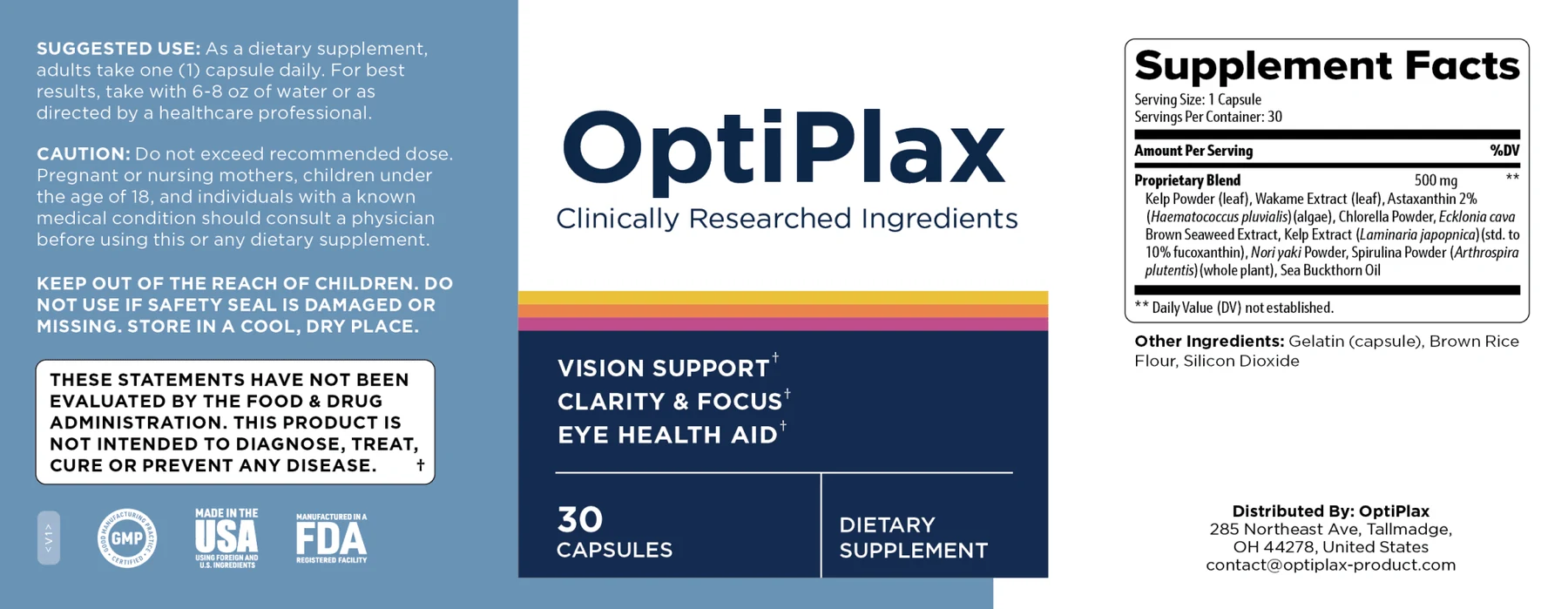
OptiPlax describes its astaxanthin as one antioxidant within a marine blend for everyday eye comfort — not a treatment, cure, or vision fix. The formula lists astaxanthin from Haematococcus pluvialis alongside a 500 mg blend of fucoxanthin-rich kelp, wakame, chlorella, spirulina and sea buckthorn oil in one daily capsule. Crucially, the label states what is inside so you can hold it against the research yourself.
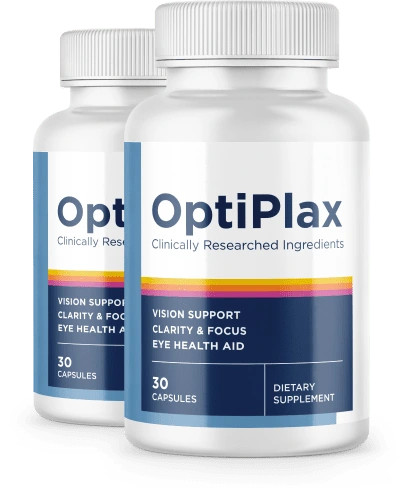
That framing is what an evidence-led product should do. Astaxanthin works best as a small, consistent part of a bigger routine — diet, screen breaks, UV protection and regular eye exams — not a standalone rescue. Read the full breakdown in the OptiPlax review and its ingredients section.
How much astaxanthin is in the research — and in OptiPlax?
Dose is where hope meets reality: the eye-comfort studies used specific amounts, and a formula either meets them or it does not. Most trials fell in the 4–12 mg per day range over several weeks, often combined with other nutrients. The table sets that research context beside the everyday support role OptiPlax describes.
| Context | Typical astaxanthin amount | What to make of it |
|---|---|---|
| Eye-fatigue trials | ~4–12 mg/day, 4–12 weeks | Where the modest comfort signals were seen; often with added nutrients. |
| General antioxidant studies | ~4–12 mg/day | Broad wellness research, not eye-specific outcomes. |
| Diet (salmon, shrimp) | Fractions of a mg per serving | Real but tiny; hard to reach study-level amounts from food alone. |
| OptiPlax daily capsule | Astaxanthin within a 500 mg marine blend | Positioned as everyday comfort support; check the label for the stated amount. |
The takeaway is not that more is automatically better — carotenoids are fat-soluble and best taken consistently with food — but that you should know the number. A product that hides it makes comparison impossible.
Who might consider astaxanthin, and who should be cautious?
Astaxanthin is a reasonable everyday antioxidant for healthy adults who spend long hours on screens and want comfort support, not a cure. It is well tolerated from algal sources at supplemental doses. Caution is still sensible: if you are pregnant or breastfeeding, take medication, or have a diagnosed eye condition, talk to your doctor first. And a real change in vision calls for an eye-care professional, not a supplement.
How do you read marine antioxidant evidence like a skeptic?
Reading marine antioxidant evidence like a skeptic means asking four questions before you believe a claim: Was it tested in people, not just cells? How many, and for how long? Was astaxanthin isolated or mixed with other nutrients? And who funded it? Apply those to any “astaxanthin for eyesight” headline and most hype collapses into a modest, honest maybe — a reason to let the label, not the landing page, guide you.
The same scepticism belongs across the whole shelf rather than to one pigment, which is the subject of do eye supplements really work. Once you have decided the category is worth trying at all, how to choose an eye health supplement turns that scepticism into a practical label checklist.
See the exact dose in OptiPlax →
OptiPlax is a dietary supplement, not a treatment for any medical condition. These statements have not been evaluated by the Food and Drug Administration. This product is not intended to diagnose, treat, cure or prevent any disease. Always consult a qualified healthcare professional about your individual needs.
Frequently asked questions
Does astaxanthin really improve eyesight?
Astaxanthin will not sharpen a prescription or reverse an eye disease, and any product promising that is overselling. It is a marine antioxidant studied mainly for eye comfort and focusing fatigue during heavy near-work, where a few small trials report modest benefits. Treat it as gentle nutritional support, not a vision cure.
What are the honest astaxanthin eye benefits?
The best-supported benefits relate to eye comfort and accommodation, the eye's ability to shift focus, and to easing the strained feeling after long screen sessions in a few small studies. None of this equals corrected vision or treatment of any diagnosed condition.
Can astaxanthin cure or reverse macular degeneration or cataracts?
No. There is no reliable human evidence that astaxanthin cures, reverses or prevents macular degeneration, cataracts or any eye disease. Claims like these are a red flag, and diagnosed conditions need a qualified eye-care professional.
How much astaxanthin was used in the eye studies?
Most eye-comfort studies used roughly 4 to 12 mg per day, often for four to twelve weeks and frequently alongside other nutrients, which makes it hard to credit astaxanthin alone. The honest reading is cautious optimism, not proof.
How does OptiPlax describe its astaxanthin?
OptiPlax presents astaxanthin from Haematococcus pluvialis as one antioxidant within a 500 mg marine blend for everyday comfort support, not a treatment. The label states the amount so you can compare it to the research, and the site avoids disease or cure claims.
Is astaxanthin safe to take for my eyes?
Astaxanthin from algae is generally well tolerated at supplemental doses in healthy adults, with few side effects reported in short studies. Even so, if you are pregnant, take medication, or have a health condition, ask your doctor before starting any supplement.
References & further reading
- Examine.com. Astaxanthin — evidence-based summary of research and dosing. examine.com/supplements/astaxanthin
- Hecht KA, et al. Astaxanthin (AstaReal) Improved Acute and Chronic Digital Eye Strain in Children: A Randomized Double-Blind Placebo-Controlled Trial. Advances in Therapy, 2025. pubmed.ncbi.nlm.nih.gov/40014233
- National Center for Complementary and Integrative Health (NCCIH). Antioxidants: In Depth. nccih.nih.gov/health/antioxidants-in-depth
- National Eye Institute (NIH). Age-Related Macular Degeneration — overview and evidence. nei.nih.gov/learn-about-eye-health/eye-conditions-and-diseases
- PubChem, U.S. National Library of Medicine. Astaxanthin — compound summary. pubchem.ncbi.nlm.nih.gov/compound/Astaxanthin
- Donoso A, et al. Therapeutic uses of natural astaxanthin: an evidence-based review focused on human clinical trials. Pharmacological Research, 2021. pubmed.ncbi.nlm.nih.gov/33549728
These references describe the ingredient and eye health in general terms and do not constitute evidence that any product treats, cures or prevents any condition.
Keep reading: astaxanthin and marine carotenoids for eyes · lutein vs astaxanthin for eyes · back to the OptiPlax blog · homepage.