Best foods and nutrients for eye health: the OptiPlax list
Updated August 2026 · reviewed by the OptiPlax Research Team. We are an independent information resource, not a medical provider, and this article is educational rather than medical advice.
The best foods for eye health are the colourful ones: carotenoid-rich leafy greens and orange vegetables, omega-3-rich oily fish, eggs, and antioxidant marine foods such as seaweed and algae. Together they supply the pigments, fats and vitamins your eyes use every day — and a varied, colourful plate is the simplest way to get them.
The eye-friendly foods and nutrients worth building into your week.
- Top foods
- Leafy greens, orange and yellow vegetables, oily fish, eggs, and marine foods such as seaweed, spirulina and chlorella.
- Key nutrients
- Lutein and zeaxanthin, the marine carotenoids astaxanthin and fucoxanthin, omega-3 fats, and vitamins C and E with zinc.
- Simplest rule
- Eat the rainbow — the more natural colour on the plate, the wider the range of protective plant pigments.
- Where OptiPlax fits
- OptiPlax concentrates antioxidant marine carotenoids into one daily capsule to complement, not replace, an eye-friendly diet.
- Timeframe
- Carotenoids build up in eye tissue over weeks to months, so nutrition is a long-term habit and results vary.
Nutrition is one of the few eye-health levers entirely in your hands, three times a day. This guide sorts the most useful foods into simple groups, shows the nutrients behind them, and explains where a marine formula like OptiPlax can top up the antioxidant carotenoids that are hardest to get from a typical diet.
Why does diet matter for your eyes?
The eye is unusually rich in specialised tissue — the light-sensing retina, the pigment-dense macula, the ever-renewing tear film — and all of it is built and maintained from what you eat. Two carotenoids in particular, lutein and zeaxanthin, physically accumulate in the macula, where they help filter high-energy light. Because the body cannot make them, they have to come from the plate. The same is true of omega-3 fats and most antioxidant vitamins: food is the supply line.
There is also a light-and-oxygen story. The retina sits at the crossroads of bright light and a rich blood supply, a combination that naturally generates reactive molecules called free radicals. Antioxidant nutrients help keep that everyday process in balance, which is why so many of the foods below are prized not for a single vitamin but for their broad spread of protective plant pigments.
What are the best foods for eye health?
Leafy greens
Spinach, kale, rocket and collard greens are the richest everyday source of lutein and zeaxanthin. A handful in a salad, smoothie or stir-fry is one of the highest-value habits for eye nutrition.
Orange and yellow produce
Carrots, sweet potato, pumpkin, yellow peppers and corn deliver beta-carotene and mixed carotenoids. The body turns beta-carotene into vitamin A, which the retina genuinely needs for the light-sensing process.
Oily fish
Salmon, sardines, mackerel and trout supply omega-3 fats that form part of the retina and the oily layer of the tear film. Two servings a week is a common general-nutrition target.
Eggs and colourful fruit
Egg yolks carry lutein in a fat-rich package the body absorbs well, while citrus, kiwi and berries add vitamin C and a spread of plant antioxidants that round out the plate.
Marine plants and algae
Seaweed, nori, spirulina and chlorella are whole-food sources of marine carotenoids such as fucoxanthin and astaxanthin, plus minerals like iodine. Long eaten in coastal diets, they are the very nutrients OptiPlax concentrates into a capsule.
| Food group | Key eye nutrient | Everyday role |
|---|---|---|
| Leafy greens | Lutein & zeaxanthin | Macular carotenoids that help filter high-energy light. |
| Orange vegetables | Beta-carotene (vitamin A) | Supports the retina’s light-sensing process. |
| Oily fish | Omega-3 fats | Part of the retina and the tear film’s oily layer. |
| Eggs | Lutein (well absorbed) | A fat-rich, everyday source of macular pigment. |
| Seaweed & algae | Fucoxanthin, astaxanthin | Marine antioxidants and minerals from whole sea plants. |
Top up marine carotenoids with OptiPlax →
Which nutrients do the heavy lifting?
Behind those foods sit a handful of nutrients that appear again and again in eye-nutrition research. Here is what each one is and why it earns its place.
The largest nutrition trial in this field is AREDS2, which tested lutein and zeaxanthin alongside omega-3 fatty acids in adults already at risk of advanced age-related macular degeneration (AREDS2 Research Group, JAMA, 2013); a later review describes how dietary zeaxanthin and lutein accumulate in macular pigment (Li X et al., Nutrition Reviews, 2023). Neither shows that food or pills sharpen already-normal sight.
| Nutrient | Found in | General role in eye nutrition |
|---|---|---|
| Lutein & zeaxanthin | Greens, corn, egg yolk | Concentrate in the macula and help filter blue light. |
| Astaxanthin | Algae, salmon, krill | A potent marine antioxidant studied for light-exposed eye tissue. |
| Fucoxanthin | Kelp and brown seaweed | The golden carotenoid of kelp, a marine antioxidant. |
| Omega-3 (DHA/EPA) | Oily fish, algae oil | Structural fats of the retina and tear film. |
| Vitamins C, E & zinc | Fruit, nuts, seeds, seafood | Everyday antioxidant and mineral support for eye tissue. |
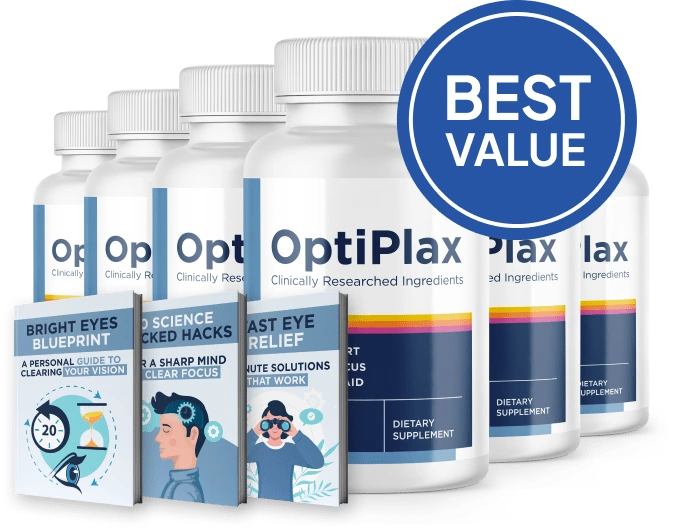
An easy marine top-up
OptiPlax pairs astaxanthin with a 500 mg blend of kelp, wakame, chlorella and spirulina in one daily capsule. The six-bottle bundle is the best value at $49 per bottle, with free U.S. shipping.
Order OptiPlax — from $49/bottleWhat does an eye-friendly day look like?
You do not need a special diet — just colour and variety across the day. A simple template:
- Breakfast: eggs with spinach, or yoghurt with berries and seeds.
- Lunch: a big mixed-leaf salad with peppers, carrot and a portion of salmon or beans.
- Snack: a handful of almonds and an orange or kiwi.
- Dinner: a colourful stir-fry with greens, and a side of seaweed or a sea-vegetable soup.
- Daily top-up: one OptiPlax capsule with water for antioxidant marine carotenoids.
Where do supplements fit?
Food comes first, always. But a typical Western diet is often light on oily fish, sea vegetables and deep-green produce, which is where a targeted supplement can help. OptiPlax focuses on the marine carotenoids — astaxanthin and fucoxanthin — that are hardest to obtain in quantity from everyday meals, delivered as one convenient capsule. For the full breakdown, read our guide to astaxanthin and marine carotenoids or see the ingredients section.
Frequently asked questions
What are the best foods for eye health?
Leafy greens such as spinach and kale, orange and yellow vegetables like carrots and peppers, oily fish, eggs, and antioxidant marine foods such as seaweed and algae. They supply the carotenoids, omega-3 fats and vitamins the eye uses every day.
Which nutrients matter most for the eyes?
Lutein and zeaxanthin, which concentrate in the macula; the marine carotenoids astaxanthin and fucoxanthin; omega-3 fats; and the antioxidant vitamins C and E plus zinc. Together they support the light-exposed tissues involved in vision.
Do carrots really help your eyesight?
Carrots supply beta-carotene, which the body converts to vitamin A — a nutrient the eye genuinely needs for the light-sensing process. Carrots will not sharpen normal vision beyond its natural level, but they are a useful part of an eye-friendly diet.
Are marine foods like seaweed good for your eyes?
Seaweed and algae are whole-food sources of antioxidant carotenoids such as fucoxanthin and astaxanthin, plus minerals like iodine. They have been eaten in coastal diets for centuries and are the marine nutrients OptiPlax concentrates into one daily capsule.
Can I get everything I need from food alone?
A varied, colourful diet is the foundation and can supply most eye nutrients. Some people use a supplement to top up specific antioxidants such as marine carotenoids, especially if their diet is low in fish, greens or sea vegetables.
How quickly does diet affect eye health?
Nutrition works gradually. Carotenoids build up in eye tissue over weeks to months of consistent intake, so an eye-friendly diet is a long-term habit rather than a quick fix. Individual results vary.
Try OptiPlax risk-free for 60 days →
OptiPlax is a dietary supplement, not a treatment for any medical condition. These statements have not been evaluated by the Food and Drug Administration. This product is not intended to diagnose, treat, cure or prevent any disease. Always consult a qualified healthcare professional about your individual needs.
References & further reading
- National Eye Institute (NIH). Keep Your Eyes Healthy — diet and nutrition. nei.nih.gov/learn-about-eye-health/healthy-vision
- National Center for Complementary and Integrative Health (NCCIH). Antioxidants. nccih.nih.gov/health/antioxidants-in-depth
- Examine.com. Astaxanthin — evidence-based summary. examine.com/supplements/astaxanthin
- Examine.com. Fucoxanthin. examine.com/supplements/fucoxanthin
- Age-Related Eye Disease Study 2 Research Group. Lutein + zeaxanthin and omega-3 fatty acids for age-related macular degeneration: the AREDS2 randomized clinical trial. JAMA, 2013. pubmed.ncbi.nlm.nih.gov/23644932
- Li X, et al. Potential roles of dietary zeaxanthin and lutein in macular health and function. Nutrition Reviews, 2023. pubmed.ncbi.nlm.nih.gov/36094616
These references describe the foods and nutrients in general terms and do not constitute evidence that any product treats, cures or prevents any condition.
Keep reading: how to support healthy vision naturally · how astaxanthin and marine carotenoids work · back to the OptiPlax blog · homepage.